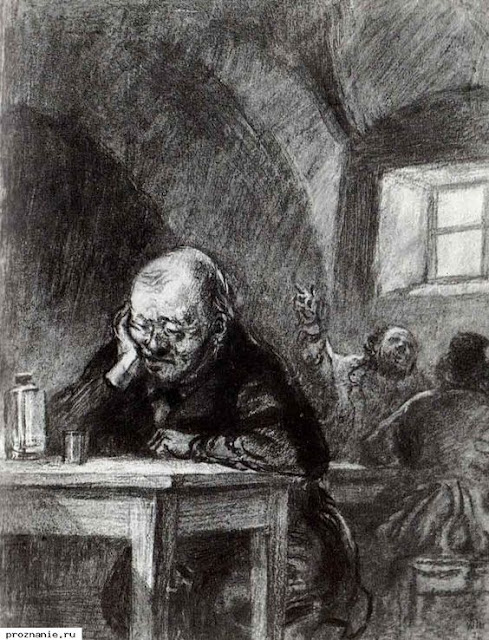
This short passage about addiction from Dostoevsky’s Crime and Punishment ought to strike a nerve for any addict or family member of an addict. It elucidates the way that addiction affects everyone and thing it touches. For context, Marmeladov’s young daughter Sonya was forced into prostitution to make ends meet for her family and their creditors when her father repeatedly drank away all their money. Her mother became abusive and hostile to all in a long-engrained defense mechanism to cope with the misery. Their youngest children are shudderingly silent, emotionally stunted and detached from it all. His drunken rant displays the categorically selfish and foolish nature of addiction, and how the sins of a father and husband can become the sins of a wife and mother, and the sins of the daughter, and so on, in inherited pain and trauma. It illustrates how we also lead others into the wrong we lead ourselves, and how no loved one is truly loved and cared for when addiction is present. But most importantly, how God – in all his inverse and counterintuitive justice – will care and forgive when we simply can’t yet. Check it out:
“Do you think, Raskolnikov, that I just drank a jug of vodka for the sake of enjoyment? Sorrow, sorrow is what I sought at its bottom, sorrow and tears, and of those I have partaken, I have found. And the one who takes pity on me, that one left, at least, is the one who takes pity on all things, all men, whose wisdom passes all understanding, he alone, that judge. One day he will find me finally to inquire, “Where is your prostitute daughter that has not spared herself for the sake of her father, the harsh-tongued, and the consumptive? For the sake of children who aren’t even her own kin? Where is your daughter, who took pity on her earthly father, on the obscene drunkard, undismayed by his bestial nature?
And he will say to her: “Come to me! I have forgiven you already once, yet your sins are so many. They are many so they may be forgiven, for you love so much! He will then judge and forgive everyone, the good and the bad, the wise and the meek. When he is done with them, he will raise his voice to us, the drunkards, and the drunkards of drunkards, “Come out! You are weak and you live in shame!”
And we will be forced to him, yet not ashamed, standing before him. He will say, “You are swine! Made in the image of the Beast, marked and branded, abandoned in selves and of others. But I tell you now, ‘Come you also.” Then the wise, good, and learned will raise in just chorus their voices, saying, “Lord! Why do you receive them?” And he alone who judges will say to them, “Because none of them ever believed themselves worthy of it.”
Then we will weep, and we will grieve. But we will understand.”
– Marmeladov’s drunken rant, ‘Crime and Punishment’
 Divided Minds: Notes on Truth
Leave a comment